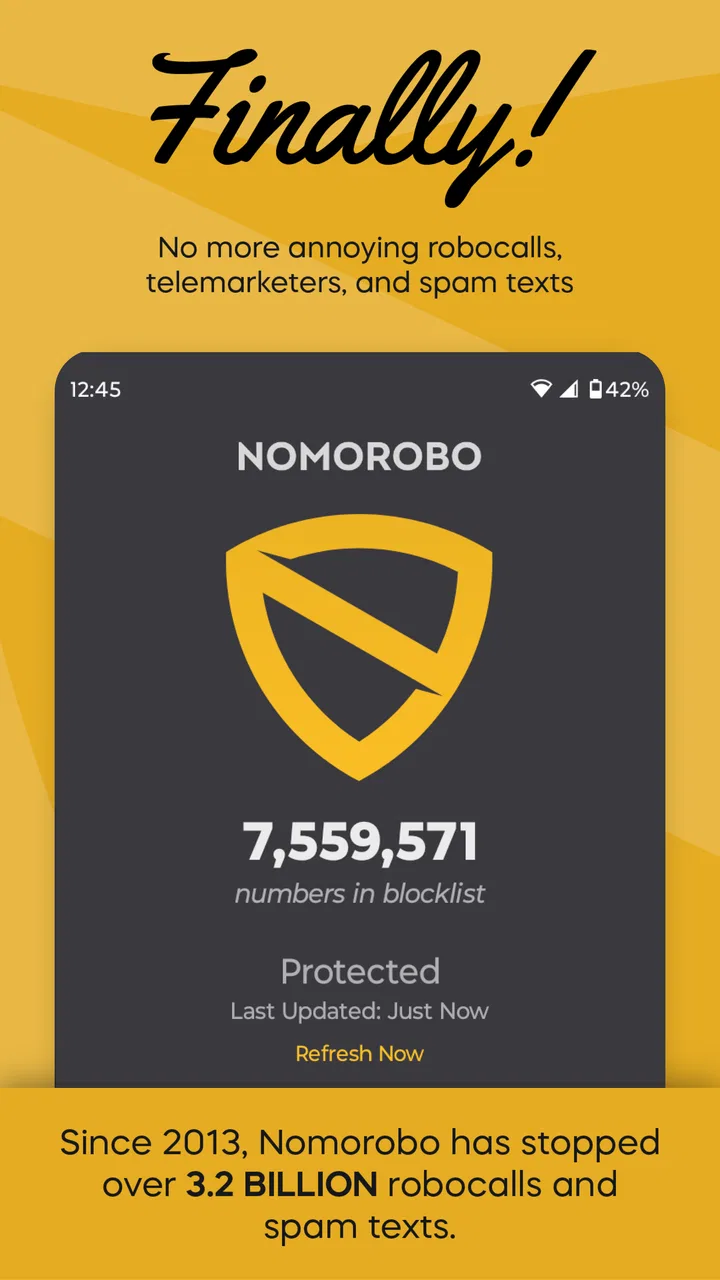
Nomorobo Basic Robocall Block
- 3.6
- Rating
- 100.00K
- Installs
- Free
- Price

 Analysis by App-foxy
Unknown numbers are rarely exciting. More often, they interrupt dinner, a work call, a child’s nap, or the few quiet minutes I have managed to protect. Nomorobo Basic Robocall Block is a free communication app from Telephone Science Corp that aims to make those interruptions less frequent by identifying and blocking robocalls, telemarketers, and phone scams. After spending time with it, I see the appeal clearly: it is not an app I open for entertainment, but a background tool that earns its place when it quietly prevents a nuisance.
My first impression was practical rather than dramatic. The app is built around a simple promise, and that simplicity is its strongest quality. I did not need to learn a social network, create a complicated calling routine, or change how I speak with people I know. The value appears when an unwanted call is handled before it becomes my problem. That makes the experience easy to understand, although it also means the app can feel invisible on days when spam activity is low.
Does Nomorobo stay useful after the first week?
During the first week, the attraction is easy to notice. I became more willing to ignore unfamiliar calls because I had another layer of protection between my phone and the people trying to reach me for the wrong reasons. That is especially helpful for anyone who receives repeated sales calls or suspicious calls that imitate legitimate organizations. Instead of treating every unknown number as urgent, I could pause and decide whether it deserved attention.
You May Also Like

 Blood Strike: 2.5 Anniversary
Blood Strike’s Loadouts Turn Every Drop Into a Tactical Gamble
A close look at Blood Strike’s custom loadouts: how fast access to signature weapons reshapes its battle royale rhythm, rewards preparation, and narrows the gap between fights.

 Pandora - Music & Podcasts
Pandora’s Music Is Easy to Start, but Harder to Recover
Pandora’s strength is its low-effort path from a seed to a station. Its weak spot is how much confidence it asks you to place in connection, setup, and quiet recovery.

 8 Ball Pool
 Is Built on Rivalries, Rematches, and Routine
A close look at the rivalries, rematches, shared routines, and unanswered safety questions that turn a quick pool match into a persistent mobile community.

 Samsung Music
’s Quiet Strength Is Playing What You Already Own
Its reach comes less from spectacle than from dependable access to a personal library. That simplicity is both the app’s strongest retention engine and its ceiling.

 AccuWeather: Weather Radar
AccuWeather Review: A Quick, Clear Forecast for Everyday Decisions
For everyday plans, the best forecast is the one you can understand quickly. AccuWeather makes rain timing, radar, and local conditions easy to act on, with a few trade-offs.

 Hill Climb Racing
Why Hill Climb Racing Still Turns Crashes Into One More Run
A tiny car, a bumpy hill and one more upgrade: Hill Climb Racing keeps resurfacing because its simple chaos makes every near-miss feel personal.
More From Our News Desk
View All News


The app’s category matters here. Nomorobo is a call-screening and communication tool, not a replacement for the phone app itself. I would not install it expecting a new dialer, a messaging service, or a complete contact-management system. Its role is narrower and more focused: reduce the amount of unwanted calling that reaches me and make unknown callers less stressful to deal with.
A realistic example is a person waiting for a delivery, a doctor’s office, or a school to call. Blocking every unfamiliar number would be risky, because an important call may come from a number that is not saved. Nomorobo is more useful in that situation than a blanket “silence all unknown callers” setting because the goal is to distinguish likely nuisance calls from ordinary unknown calls. I still would not treat any automated filter as perfect, but this approach is more practical than simply shutting the door on every number outside my address book.
The first-week benefit is also psychological. Spam calls create a small decision each time: answer, reject, search the number, or wait for a voicemail. Repeating that decision throughout the day is tiring. A dedicated blocker reduces the number of moments in which I have to make that choice. The real benefit is fewer interruptions, not a more exciting phone experience.
At the same time, the initial setup and adjustment period deserve realistic expectations. Any call-filtering app has to fit into the phone’s calling behavior, and users should pay attention to how it handles suspected spam before relying on it completely. I recommend keeping an eye on the first few incoming calls and checking whether important callers are still reaching me normally. That small observation period is more valuable than switching it on and forgetting about it immediately.
Nomorobo has an average rating of 3.6 from around 2.6 thousand ratings, with roughly 1.6 thousand written reviews. I read that as a sign of a useful but not universally effortless service. People who are overwhelmed by robocalls may find the benefit obvious, while people who receive very few nuisance calls may see little reason to keep another communication app involved. The difference comes down to how much unwanted calling is already costing the user in time and attention.
Where the lasting value comes from
After the novelty fades, the app has to justify staying installed through repetition. In my view, it does that when the phone is used for work, family coordination, appointments, or any situation where interruptions have a real cost. The app does not need to impress me every day. It only needs to reduce enough unwanted activity that I notice the difference over time.
That recurring value is different from the value of a traditional caller-identification feature. A caller ID tool helps me decide what to do after I see a call. Nomorobo is more proactive: it is intended to stop nuisance traffic from becoming an interruption in the first place. The trade-off is that proactive filtering demands trust. I am asking the app to make a judgment before I do, so I care more about consistency and false positives than I would with a simple lookup tool.
It also differs from relying only on the phone’s built-in blocking options. Manual blocking works well for a persistent individual number, but it becomes frustrating when unwanted callers rotate through many numbers. I do not want to maintain a personal blacklist every time a new number appears. A specialized service makes more sense for the broader pattern of robocalls and telemarketing, while manual blocking remains useful for specific callers who continue to get through.
For families, the value can be less about personal annoyance and more about reducing risky conversations. Older relatives and less confident phone users may be more likely to answer a convincing scam call. Nomorobo cannot replace judgment or education, but it can reduce exposure to some of those interruptions. I would present it as one protective habit alongside checking suspicious requests independently, never sharing sensitive information during an unexpected call, and using known contact methods for banks or public services.
There is also a useful trade-off for people who depend on calls from new customers. A freelancer, contractor, property manager, or small business owner may receive legitimate calls from numbers that look unfamiliar. In that case, aggressive filtering can be inconvenient. I would use the app more cautiously in that environment and make sure callers have another way to leave a message or contact me. The best fit is not simply “anyone with a phone”; it is someone whose incoming call burden is dominated by nuisance traffic rather than genuine new contacts.
What maintenance really involves
The maintenance burden is relatively light in concept, but it is not zero. A call blocker needs to remain part of the phone’s normal calling workflow, and I would periodically check that it is still behaving as expected after phone updates or changes to my calling habits. I would also review blocked or flagged activity when something seems unusual, especially if I am waiting for an important call.
That habit matters because filtering tools can create two opposite mistakes. They may allow an unwanted call through, or they may treat a legitimate call as suspicious. The first is annoying; the second can be costly. I would never use Nomorobo as a reason to stop checking voicemail or to assume that every blocked call was malicious. The sensible routine is to let the app reduce noise while keeping a backup path for people who genuinely need to reach me.
Another practical tip is to keep important numbers saved and current. A blocker works within a larger phone environment, and clear contacts make my own decisions easier. If a medical office, school, delivery service, or workplace uses changing numbers, I would ask how they identify themselves and how they handle missed calls. That preparation reduces the chance that I mistake a legitimate unknown call for spam.
Nomorobo is free to install, but it includes in-app purchases ranging from $2.99 to $49.99 per item. That makes it important to think about the long-term cost before committing to any paid option. I would first decide whether the basic experience solves my problem and whether the app’s ongoing value is high enough to justify spending more. Someone who receives only occasional spam may be satisfied without paying, while a person whose workday is repeatedly interrupted may consider additional spending more reasonable.
The app is rated for Everyone, which fits its straightforward purpose. Still, an age rating does not mean every user should configure it without supervision. Children, older adults, and people who rely heavily on calls may need a quick explanation of what the app is doing and what to do when an expected caller does not get through. The safest setup is one that combines filtering with a clear plan for recovering important communication.
Why some users may become tired of it
The first source of fatigue is uncertainty. When a filter works well, it is easy to forget it exists. When a legitimate call is delayed, blocked, or treated differently from what I expect, my confidence drops quickly. Even a small number of questionable decisions can make me wonder whether I should inspect every call manually, which defeats much of the convenience.
The second is the feeling that the app is another layer to monitor. People who already use built-in phone protection, carrier-level spam controls, or a separate caller-identification service may not want overlapping tools. Multiple filters can make troubleshooting harder because I may not know which one handled a call. In that situation, Nomorobo is most attractive when it replaces a weaker or more labor-intensive method rather than simply adding another badge to the phone.
There is also a privacy and trust consideration that I would not dismiss. A communication app involved in call screening sits close to a sensitive part of daily life. Before installing or paying for any service in this category, I would read its current permissions and privacy information directly in the app store and on the developer’s official pages. I am not saying this product is unsuitable; I am saying that call protection should be judged partly by whether the user is comfortable with how that protection operates.
Another limitation is that no filter can solve the entire scam problem. Fraudsters change tactics, use convincing stories, and sometimes reach people through text messages, email, social networks, or messaging apps rather than ordinary phone calls. Nomorobo is therefore not a general security suite. If my main concern is phishing links, account theft, or suspicious messages, I would need other safeguards. Installing this app should make me more selective, not more trusting.
Some users may also dislike the lack of visible drama. There is no daily reward, social feed, or satisfying completion screen. The product’s success is measured by interruptions that never become memorable. That is excellent for a utility, but it can make the app feel unnecessary when the phone is having a quiet month. I judge it by the pattern over time rather than by whether I notice it every morning.
Who should install it, and who should skip it?
I would recommend Nomorobo to people who receive frequent robocalls, telemarketing calls, or suspicious phone scams and are tired of handling them one by one. It is also worth considering for households where unwanted calls create confusion or anxiety. The free entry point makes it easy to test whether a dedicated blocker improves the daily phone experience before making a larger commitment.
I would be more cautious about recommending it to people who receive very few unknown calls, depend on every possible new caller, or already have a carrier and phone setup that handles spam well. For them, the extra layer may not produce enough benefit to justify the attention it requires. I would also hesitate for users who expect a complete communications manager, because this app has a focused purpose rather than a broad collection of calling features.
Nomorobo has been available since October 26, 2017, and its listing shows over 100 thousand installs. That history and reach suggest that it is not merely a novelty experiment, but those figures do not remove the need to test how it fits a particular phone routine. Spam patterns vary widely by person, region, occupation, and public exposure. My experience with it would not automatically predict yours.
One of the most useful ways to evaluate it is to compare your routine before and after installation. For several days, notice how often an unwanted call interrupts you, how much time you spend checking numbers, and whether you miss any expected calls. Then repeat the same observation after the app has settled into your routine. This is more meaningful than judging it after one blocked call or one call that still gets through.
My long-term verdict
Nomorobo Basic Robocall Block earns lasting space on my phone when I treat it as quiet maintenance rather than a magic shield. Its best quality is that it targets a repetitive problem with a focused solution. I do not need to remember every suspicious number, and I do not have to turn every unknown call into a research task. For a person whose day is regularly interrupted by nuisance calls, that reduction in friction can remain valuable long after the initial installation.
My reservation is that call filtering always involves a trust decision. I would keep important contacts updated, check voicemail, remain alert for expected calls, and avoid assuming that a blocked or allowed call is automatically safe. I would also review the paid options carefully, because the presence of in-app purchases means the free starting point is not the whole financial picture.
In the end, I see this as a practical app for a specific annoyance, not something every phone needs by default. If robocalls are a daily interruption, the focused protection is likely to feel worthwhile. If unknown calls are rare or every new caller matters to your work, the trade-offs deserve more thought. After the novelty fades, its value comes down to one question: does it consistently give you back more attention than it asks you to spend maintaining it? For the right user, my answer is yes.
FAQs for Nomorobo Basic Robocall Block
01What is Nomorobo Basic Robocall Block and how does it work?
Nomorobo Basic Robocall Block is designed to help identify and reduce unwanted robocalls, telemarketing calls, and suspected scam numbers. After installation, the app checks incoming calls against its call-protection service and can warn you when a number appears suspicious. Depending on your device and settings, it may also block selected calls automatically or allow you to review them before answering.
02Does Nomorobo Basic Robocall Block block every spam or scam call?
No call-blocking application can guarantee that every unwanted call will be stopped. Nomorobo relies on regularly updated information about reported robocallers and suspicious numbers, so newly created or frequently changing numbers may occasionally get through. During testing, the app is most useful as an additional layer of protection, but users should still avoid sharing personal information and remain cautious with unexpected callers.
03Is Nomorobo Basic Robocall Block free to download and use?
Nomorobo Basic Robocall Block may be available to download without an upfront charge, although the exact features, limitations, and subscription options can vary by platform, region, and current app version. Before activating any premium protection, review the price, billing period, and renewal terms shown in the App Store or Google Play. The basic experience may offer fewer features than paid plans.
04Does the app work on both Android and iPhone?
Nomorobo’s availability and call-blocking behavior can differ between Android and iOS because each operating system provides different permissions and call-screening tools. Before downloading, check the app-store listing for your device model, operating-system version, and supported features. You may need to enable call identification, blocking, or related permissions manually for the protection to work as intended.
05Will Nomorobo Basic Robocall Block affect my contacts or normal phone calls?
The app is intended to target numbers identified as unwanted rather than block calls from people in your address book. However, no filtering database is perfect, and an incorrectly classified number could potentially be flagged. It is a good idea to review the app’s blocking settings, keep important contacts saved, and check blocked or identified calls regularly so legitimate calls are not missed.
Pros
- Blocks many known robocallers before your phone rings.
- Can help reduce scam
- telemarketing
- and political calls.
- Offers caller identification for suspicious incoming numbers.
- Simple setup with clear call-screening controls.
- Useful for users who receive frequent unwanted calls.
Cons
- Effectiveness depends on regularly updated caller databases.
- Some legitimate calls may be flagged or blocked incorrectly.
- May require access to call-related permissions on your device.
- Unknown or newly created scam numbers can still get through.
- Features and availability may vary between Android and iOS.

Nomorobo Basic Robocall Block
Gallery